Phone Addiction Assessment
If you think you are addicted to your phone - you are.
5 Signs You're Addicted:
- ✓ You check your phone within 5 minutes of waking up
- ✓ You feel anxious or irritable without it nearby
- ✓ You prioritize phone use over face-to-face conversations
- ✓ You lose track of time while scrolling social media
- ✓ Your sleep quality suffers because of nighttime phone use
Take the 3-minute HDI test to measure your phone addiction across 6 validated dimensions - and get a personalized path to digital freedom.
⚡ Instant results · No credit card required · 100% confidential
Defining Digital Wellbeing
Digital wellbeing is the state in which a person maintains a conscious, balanced, and healthy relationship with digital technology. It encompasses attention span, emotional regulation, sleep quality, social connection, and digital resilience. Unlike screen time tracking, digital wellbeing measures how technology shapes who you are - not just how much you use it.
The concept gained urgency as smartphone adoption accelerated after 2010–2012. Jean Twenge's Monitoring the Future study - tracking 8th, 10th, and 12th graders since 1976 - found a direct correlation between increased screen activity and rising depressive symptoms.
Depressive symptoms among teenagers doubled in the years following peak smartphone adoption. Social media platforms are engineered to hold attention through variable ratio reinforcement - the same psychological mechanism that makes slot machines addictive.
Social media sends a dopamine spike every 20–30 seconds. These spikes condition the brain to expect constant stimulation. Constant stimulation gradually destroys the capacity for deep, uninterrupted focus - the cognitive state where meaningful work, learning, and connection actually happen.
Finally, a framework exists that goes beyond "spend less time on your phone." The Human Digital Index (HDI) - developed by Tomislav Krištof, Senior Lecturer and PhD Candidate at Algebra Bernays University - measures your digitality across 6 validated dimensions, identifies your specific vulnerabilities, and provides a structured path to change.
The Digital Sadness Generation
We mask exhaustion behind Instagram filters. We scroll four hours a day, yet wonder why focus collapses by 10:00 AM. Digital overload is not a character flaw - it is a measurable neurological pattern with a measurable solution.
Teen Depression Rate
Depressive symptoms among teenagers doubled after 2012 - the year smartphone adoption reached critical mass. Source: Monitoring the Future / Jean Twenge.
Lost After Each Interruption
Every phone notification requires 23 minutes to fully restore deep focus. The average person receives 80+ notifications per day.
Find Longer Content Stressful
50% of regular TikTok users report that longer video formats feel stressful - evidence of measurable attention fragmentation.

The "Digital Sadness Generation"
The Digital Sadness Generation - a term coined by Tomislav Krištof - describes the cohort masking emotional struggles behind curated social media personas. The performance of happiness online amplifies the gap between projected identity and authentic inner experience.
Cortisol - the primary stress hormone - rises with every notification. Elevated cortisol blocks serotonin production. Blocked serotonin is the biological foundation of digital fatigue, anxiety, and the persistent emptiness that high social media users report.
Even if you have tried digital detoxes, app timers, or notification blockers - and they worked for three days - HDI addresses the root cause: your brain's learned response to digital stimulation, measured across 6 specific dimensions.
Research Data: Depressive Symptoms in US Teenagers, 1991–2023
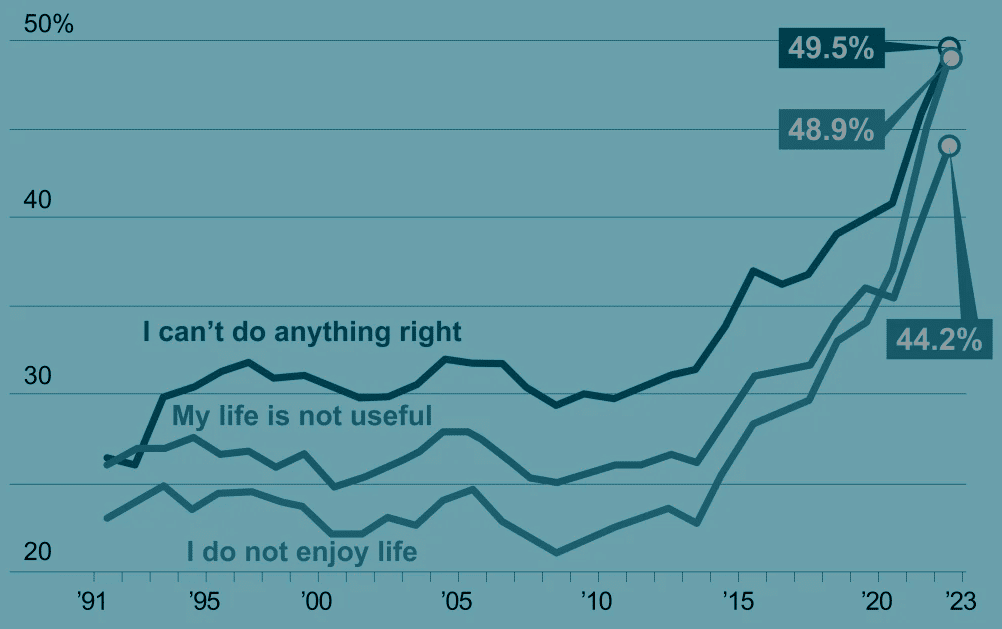
Source: Monitoring the Future, analyzed by Jean M. Twenge
What is Digitality?
Digitality is the totality of your relationship with digital technology - how you use it, how it shapes your identity, how resilient you are to its threats, and how it affects your mental and physical health. Coined by Tomislav Krištof as the foundational concept of the Human Digital Index. © 2026 Tomislav Krištof, HDI.Vision
Screen time is one data point. Digitality is the full picture. Two people spending four hours daily on their phones may have radically different digitality profiles - one is building a business and maintaining deep friendships; the other is compulsively checking for social validation and experiencing measurable anxiety when separated from the device.
Without measuring the specific dimensions of your digitality, intervention is guesswork. HDI.Vision provides the first validated instrument to map all six.
The 6 Dimensions of Digitality
The Human Digital Index measures your relationship with technology across six evidence-based dimensions. Each dimension reveals a different vulnerability - and a different path to improvement.
© 2026 Tomislav Krištof, HDI.Vision. The Human Digital Index model and its 6 dimensions are original works first published on this site.
01 / Digital Health
How technology impacts your body and mind
Digital Health measures the physical and mental impact of your technology use - eye strain, disrupted sleep, sedentary behaviour, and compulsive checking. MRI research from 2018 shows visible structural atrophy in the brains of children aged 9–10 who use smartphones for more than seven hours per day.

02 / Digital Personality
Online persona vs. authentic self
Digital Personality examines the gap between your online persona and who you actually are. It measures whether your digital behaviour reflects genuine identity - or a constructed image optimised for external validation. A low score correlates directly with unstable self-esteem and compulsive social comparison.

03 / Digital Integration
How deeply digital is embedded in your life
Digital Integration measures how deeply the digital world is embedded in your daily life - and whether that integration serves you or consumes you. High integration is not inherently negative. The dimension reveals whether your digital presence amplifies your real-world goals or replaces them.

04 / Digital Resilience
Your capacity to withstand digital threats
Digital Resilience measures your capacity to withstand digital threats - from cybersecurity risks and AI disruption to misinformation and cognitive erosion by algorithmic content. At the dawn of AI, resilience is no longer optional. Bruce Lipton's research shows that "protection mode" and "growth mode" cannot coexist biologically.
05 / Digital Influence
Your ability to impact others online
Digital Influence assesses your ability to impact others online - and whether that influence is authentic, constructive, and ethically grounded. Low scores do not mean invisibility. They reveal a misalignment between your knowledge, your voice, and your online presence - a gap that structured education can close.

06 / Digital Business
Converting digital fluency into results
Digital Business measures your ability to convert digital fluency into professional results - through e-commerce, digital marketing, remote collaboration, or AI-augmented work. Organizations that score teams on Digital Business identify the gap between digital tool adoption and digital tool mastery.
Signs of Digital Overload
Digital overload does not announce itself. It arrives as reduced attention span, as irritability when the phone is out of reach, as the inability to sit with silence. These indicators - identified through HDI research - signal a measurable decline in digital wellbeing.
- You check your phone within 5 minutes of waking up
- Longer content - articles, books, films - feels effortful or boring
- You feel anxious when separated from your device
- You open social media without a specific purpose
- You compare your life or achievements to others online
- Face-to-face conversation feels less natural than digital communication
- You scroll to manage boredom, loneliness, or discomfort
- Sleep quality has declined - phone use within 1 hour of bedtime
- Deep focus - uninterrupted work for 45+ minutes - feels rare
- You feel tired despite adequate sleep, with no medical explanation
Three or more of these indicators suggest measurable digital overload. The HDI assessment identifies which specific dimensions are affected - and why generic advice has not resolved them.
What Overload Does to Your Brain
Healthy cognitive rhythms alternate between Beta states (active thinking) and Alpha states (relaxed awareness, daydreaming, rest). Alpha is the neurological space where creativity, emotional processing, and memory consolidation occur.
Social media locks the brain in continuous Beta - even during passive scrolling. The content is engineered to sustain arousal, not deliver rest. This is measurable via EEG - not metaphor.
The result is chronic Alpha deficiency: an inability to daydream, to sit with silence, to access genuine emotional states without digital mediation. It correlates with reduced emotional intelligence, social withdrawal, and compulsive behaviour.
Research Finding
"Devoted TikTok users report they are unable to focus on longer video formats anymore. 50% of users admit that longer videos feel stressful." - Social Media Psychology, 2022
Croatian Data
Over 50,000 children in Croatia have mental health difficulties. Only 55 child psychiatrists serve them. 4,000+ children received school entry delays in 2022 linked to excessive screen exposure. - Ella Selak Bagarić, Croatian Psychological Chamber (2022)
The Science Behind Digital Wellbeing
HDI.Vision draws on peer-reviewed research in cognitive neuroscience, behavioral psychology, and organizational behavior. These are the mechanisms your phone exploits - and that the HDI model addresses.
Mechanism 01
The Dopamine Loop
Nathalie Nahai's research on persuasive technology identifies the dopamine loop: the "want" signal (dopamine) precedes every action, while the "like" signal (opioid) follows reward. Variable-ratio reinforcement - the same principle behind gambling addiction - means unpredictable rewards produce the strongest conditioning.
TikTok's algorithm is calibrated to this unpredictability with mathematical precision. Your brain does not know when the next compelling video arrives - so it never stops looking.
Mechanism 02
The Cortisol Cascade
Higher social media usage correlates with elevated salivary cortisol - the primary stress hormone. Cortisol activates "protection mode": a biological state incompatible with growth, creativity, and learning. In protection mode, the body suppresses serotonin and oxytocin - the hormones governing mood and social bonding.
This is the biochemical mechanism behind digital fatigue that screen time apps cannot detect.
Mechanism 03
The Attention Economy
Sokolov's habituation research and Krugman's media processing studies converge: passive digital consumption creates the impression of relaxation while maintaining cortical arousal. The brain habituates to stimulation - requiring more novelty for the same response.
Barry Schwartz's paradox of choice compounds this: infinite scroll creates a state of perpetual choice that produces anxiety, not satisfaction. More options equal less meaning.
The HDI Intervention Framework
Identifying the problem is the beginning, not the solution. HDI.Vision's proprietary 15-pillar framework - developed by Tomislav Krištof and validated at Algebra Bernays University - provides a structured path from digital overload to genuine digital wellbeing.
© 2026 Tomislav Krištof, HDI.Vision. All six models below are original works first published on this site.
Entry Point Model
3D Model: Divert · Discomfort · Delight
The 3D Model reframes the challenge: instead of resisting your phone through willpower - which relies on a volitional moment that digital overload has already weakened - you replace the stimulus.
Divert - redirect the dopamine flow from the phone toward a healthier phone-free reward. Where is the competing reward?
Discomfort - accept the short-term discomfort. "Am I normal? What am I doing here?" - this is not failure; it is the inflection point.
Delight - the activity where you lose track of time. Finding it is worth a lifetime.
D
Divert
Competing reward
D
Discomfort
Inflection point
D
Delight
Long-term goal
The 3D Model is the entry point. Each subsequent model addresses a deeper layer - from physical separation to existential meaning.
Separation · Solitude · Success
Create physical distance from devices. Learn to exist in solitude without anxiety. Success follows from the space you reclaim.
Nourishment · Nurture · Natural
Feed body and mind with quality inputs. Nurture real relationships. Return to natural rhythms - sleep, movement, presence.
Outdoors · Others · Outstanding
Physical activity in nature restores Alpha brain states. Live connection replaces digital substitutes. Excellence emerges in the physical world.
Faith · Forgiveness · Fortitude
Viktor Frankl showed that meaning - not pleasure or power - is the deepest human motivation. Faith in something larger than the feed. Fortitude as the courage to live authentically.
Alertness · Awe · Achievement
"I observe my own thought, therefore I am." Alertness is the highest digital resilience. Awe restores neurological depth. Achievement, finally, means something.
Focus · Filter · Flow
Designed for organizational contexts. Focus on what produces real output. Filter the digital noise that masquerades as work. Flow is the state where productivity and wellbeing converge - the measurable goal of any corporate digital wellbeing program.
Pilot Program
Not Ready to Commit? Start with a Pilot.
Assessment for up to 15 people, one workshop session, full team report - €500. Applies toward any full program if you continue.
Request Pilot Program
You Already Know Something Is Off
Without a map of your specific digital vulnerabilities, change is arbitrary. The HDI assessment takes 7–60 minutes depending on depth, and produces a dimensional profile that finally explains why screen time limits alone have not worked.
HDI.Vision combines the assessment with evidence-based education programs - for individuals, teams, schools, and organizations - designed by Tomislav Krištof, Senior Lecturer and PhD Candidate at Algebra Bernays University.
Understanding your digitality is the first step. Understanding becomes change only through the structured intervention the HDI framework provides. And change, measured through re-assessment, becomes the evidence of what is possible.
Frequently Asked Questions
If you think you're addicted to your phone - you are. Here are the signs: you check your phone within 5 minutes of waking up, you feel anxious or irritable without it, you prioritize phone use over face-to-face relationships, you lose track of time while scrolling, and your sleep quality suffers. The average American checks their phone 96 times per day - every 10 minutes. Take the free HDI test to measure your phone addiction across 6 dimensions and get a personalized intervention path.
Digital wellbeing is the state in which a person maintains a conscious, balanced, and healthy relationship with digital technology. It encompasses attention span, emotional regulation, sleep quality, social connection, and digital resilience - measured across 6 validated dimensions in the Human Digital Index.
Digitality is the totality of your relationship with digital technology - how you use it, how it shapes your identity, how resilient you are to its threats, and how it affects your mental and physical health. The term was coined by Tomislav Krištof as the foundational concept of the Human Digital Index. © 2026 Tomislav Krištof, HDI.Vision.
The Human Digital Index measures:
- Digital Health - physical and mental impact of technology use
- Digital Personality - alignment between online and authentic self
- Digital Integration - depth of digital embeddedness in daily life
- Digital Resilience - capacity to withstand digital threats and AI disruption
- Digital Influence - ability to impact others online constructively
- Digital Business - ability to generate career and financial value through digital tools
The Digital Sadness Generation is a term coined by Tomislav Krištof describing people - predominantly Gen Z and younger Millennials - who mask emotional struggles behind curated social media personas. Jean Twenge's Monitoring the Future research confirms depressive symptoms among teenagers doubled since social media's emergence. © 2026 Tomislav Krištof, HDI.Vision.
Screen time counts hours. The Human Digital Index measures impact - specifically how technology shapes your attention span, self-esteem, resilience, social skills, and professional performance across 6 dimensions. HDI also provides a complete intervention path: from assessment to personalized education to behavioral change to re-assessment. No screen time tracker does this.
Yes. The HDI assessment was developed and validated at Algebra Bernays University by Tomislav Krištof, mag. oec., Senior Lecturer and PhD Candidate in Digital Behaviour. The model draws on peer-reviewed research by Jean Twenge, Nathalie Nahai, Barry Schwartz, and Bruce Lipton.
The HDI Intervention Framework is a proprietary 15-pillar system by Tomislav Krištof, consisting of five sequential models: 3D (Divert · Discomfort · Delight), 3S (Separation · Solitude · Success), 3N (Nourishment · Nurture · Natural), 3O (Outdoors · Others · Outstanding), 3F (Faith · Forgiveness · Fortitude), and 3A (Alertness · Awe · Achievement). Each addresses a progressively deeper layer of digital wellbeing. © 2026 Tomislav Krištof, HDI.Vision.